<?xml version="1.0" encoding="utf-8" standalone="yes"?>
<feed xmlns="http://www.w3.org/2005/Atom">
  <title>cliffmccarthy.net</title>
  <link href="https://www.cliffmccarthy.net/pages/feed.xml" rel="self" type="application/atom+xml"/>
  <link href="https://www.cliffmccarthy.net/pages/" rel="alternate" type="text/html"/>
  <updated>2026-04-02T12:49:02-05:00</updated>
  <id>https://www.cliffmccarthy.net/pages/</id>
  <author><name></name></author>
  <generator>Hugo -- gohugo.io</generator>
  <entry>
    <title type="html"><![CDATA[Escher&#39;s Elevator]]></title>
    <link href="https://www.cliffmccarthy.net/pages/Escher%27s_Elevator/"/>
    <published>2026-01-27T13:20:05-06:00</published>
    <updated>2026-02-05T14:13:12-06:00</updated>
    <id>https://www.cliffmccarthy.net/pages/Escher&#39;s_Elevator/</id>
    <content type="html"><![CDATA[<p><a href="http://www.magpu.com/ee/">Escher&rsquo;s Elevator</a>
is a project Kurt Kistler and I started in October
2004.  We sought a new approach to making music, exploring the world of
sound through use of widely varied textures and tone colors.  We use a
vast array of instruments and equipment, including synthesizers,
samplers, guitars, effects, and acoustic percussion, and loops.  In
2005, Erich Schriefer joined us with his own vast array of instruments,
effects, and gizmos.</p>
<p>We have performed live improvised sets a few times, and have an
extensive collection of recordings of our rehearsals.</p>
]]></content>
  </entry>
  <entry>
    <title type="html"><![CDATA[File Reference Hierarchy]]></title>
    <link href="https://www.cliffmccarthy.net/pages/file-reference-hierarchy/"/>
    <published>2024-02-01T04:19:27+00:00</published>
    <updated>2026-02-11T08:17:57-06:00</updated>
    <id>https://www.cliffmccarthy.net/pages/file-reference-hierarchy/</id>
    <content type="html"><![CDATA[<p>This is the relationship between files in the theme.  This site has
been de-themed, but some or all of this may still apply.</p>
<div class="codeblock"><pre tabindex="0"><code>                                                              .-&gt; layouts/partials/head/css.html --&gt; assets/css/main.css
                              +-&gt; layouts/partials/head.html -+
                              |                               &#39;-&gt; layouts/partials/head/js.html --&gt; assets/js/main.js
                              |
layouts/_default/baseof.html -+-&gt; layouts/partials/header.html --&gt; layouts/partials/menu.html
                              |
                              +-&gt; layouts/partials/footer.html

layouts/_default/home.html (right arrow on links)

layouts/_default/list.html (scroll on links)

layouts/_default/single.html --&gt; layouts/partials/terms.html

layouts/pages/list.html (page icon on links) (added after creating theme)

content/_index.md

content/pages/_index.md (added after creating theme)

static/favicon.ico</code></pre></div><p>GoAT information: <a href="https://gohugo.io/content-management/diagrams/">https://gohugo.io/content-management/diagrams/</a></p>
<h2 id="first-class-concepts-in-hugo">First-class concepts in Hugo</h2>
<p>Hugo has built-in knowledge of specific categories of templates:</p>
<ul>
<li>Base</li>
<li>Single page</li>
<li>Home page (is a Page)</li>
<li>List</li>
<li>Section (is a List)</li>
<li>Taxonomy (is a List)
<ul>
<li>&rsquo;tags&rsquo; and &lsquo;categories&rsquo; are auto-configured.</li>
<li>They can be removed with disableKinds.</li>
<li><a href="https://gohugo.io/content-management/taxonomies/#add-taxonomies-to-content">https://gohugo.io/content-management/taxonomies/#add-taxonomies-to-content</a></li>
</ul>
</li>
</ul>
<p>&ldquo;Section&rdquo; divides its sub-items into groups, each in a single section.
&ldquo;Taxonomy&rdquo; can have overlapping sub-items, with each appearing in
multiple groups.  A typical use case for this is tags.</p>
<p>RSS happens automagically?</p>
<p>page kind: A classification of pages, one of home, page, section,
taxonomy, or term.  Note that there are also RSS, sitemap, robotsTXT,
and 404 page kinds, but these are only available during the rendering
of each of these respective page&rsquo;s kind and therefore not available in
any of the Pages collections.</p>
<h2 id="markdown-files">Markdown files</h2>
<p>This describes how things worked before the site was de-themed.</p>
<ul>
<li>The <strong>pages</strong> section gets its index text from local content, that shadows the index defined in the theme.</li>
<li>The <strong>posts</strong> section gets its index text from local content.</li>
</ul>
<div class="codeblock"><pre tabindex="0"><code>  themes/fromblank/content/_index.md --&gt; public/index.html

[ themes/fromblank/content/pages/_index.md ]
             |
             &#39;---- content/pages/_index.md --&gt; public/pages/index.html

                   content/pages/useful-links/index.md --&gt; public/pages/useful-links/index.html

                   content/posts/_index.md --&gt; public/posts/index.html</code></pre></div>]]></content>
  </entry>
  <entry>
    <title type="html"><![CDATA[Static web ecosystem]]></title>
    <link href="https://www.cliffmccarthy.net/pages/static-web-ecosystem/"/>
    <published>2022-05-09T01:25:29+00:00</published>
    <updated>2026-03-16T07:54:32-05:00</updated>
    <id>https://www.cliffmccarthy.net/pages/static-web-ecosystem/</id>
    <content type="html"><![CDATA[<p>Making a static site work requires dealing with many areas of knowledge:</p>
<div class="codeblock"><pre tabindex="0"><code>                                 +-----+
                                 | CSS |
                                 +-----+

                   +-------+     +------+
                   | Theme |     | HTML |
                   +-------+     +------+        +---------+
    +--------+                                   |         |
    | Golang |                   .------------.  |         |
    +--------+     +-------+     | JavaScript |  | Browser |
                   | Hugo  |     &#39;------------&#39;  |         |
                   +-------+                     |         |
  .------------.                 .------------.  +---------+
  | Go         |                 | JavaScript |
  | templates  |  +---------+    | libraries  |
  &#39;------------&#39;  | Content |    &#39;------------&#39;
                  +---------+</code></pre></div>]]></content>
  </entry>
  <entry>
    <title type="html"><![CDATA[Hard Drive Recovery]]></title>
    <link href="https://www.cliffmccarthy.net/pages/Hard_Drive_Recovery/"/>
    <published>2013-03-17T18:09:44-05:00</published>
    <updated>2026-02-05T14:13:12-06:00</updated>
    <id>https://www.cliffmccarthy.net/pages/Hard_Drive_Recovery/</id>
    <content type="html"><![CDATA[<p>A while back, I had to recover as much data as possible from a trashed hard drive.  Here are some notes I put together about useful tools:</p>
<p><a href="http://www.gnu.org/software/ddrescue/ddrescue.html">ddrescue</a>:
This copies data off the raw device like dd, but handles I/O errors
better, so it can be used to make an image of a damaged device,
capturing as much as is readable.</p>
<p><a href="http://www.cgsecurity.org/wiki/TestDisk">TestDisk</a>:
This has a slightly annoying UI but can identify files in an NTFS
filesystem that have been deleted and recover them.  Because it
understands the filesystem, I think it can recover files that are
fragmented.</p>
<p><a href="http://www.cgsecurity.org/wiki/PhotoRec">PhotoRec</a>:
This program scrapes the raw disk image and spits out anything that
looks like a file.  This can find stuff even if there aren&rsquo;t
pointers to it in the NTFS file index.  It will also find tons of
junk you don&rsquo;t want.  It can&rsquo;t deal with files that are fragmented,
but operating systems try to write files contiguously as much as
possible, so this can do a pretty good job of digging up things that
have been lost.</p>
]]></content>
  </entry>
  <entry>
    <title type="html"><![CDATA[Roland D-50 Battery]]></title>
    <link href="https://www.cliffmccarthy.net/pages/Roland_D-50_Battery/"/>
    <published>2013-02-24T13:57:21-06:00</published>
    <updated>2026-02-05T14:13:12-06:00</updated>
    <id>https://www.cliffmccarthy.net/pages/Roland_D-50_Battery/</id>
    <content type="html"><![CDATA[<p>After a while of warning me to check the internal battery, my Roland D-50 synthesizer came up recently with all its internal presets gone, and random garbage for settings.  After nearly 25 years of service, that little lithium battery finally gave out.</p>
<p>Replacing the battery is fairly straightforward.  It&rsquo;s a CR2032 button cell.  To access it, you first have to remove the five screws across the bottom edge of the back panel, and every screw on the bottom panel (there are lots of them).  After you do that and remove the bottom sheet metal cover, this is what you&rsquo;ll find, minus the big yellow arrow pointing at the battery:</p>
<p><img src="http://www.cliffmccarthy.net/images/roland_d50/roland_d50_inside_full.jpg" alt="image"></p>
<p>Here&rsquo;s a closer view of the main board, where the battery resides:</p>
<p><img src="http://www.cliffmccarthy.net/images/roland_d50/roland_d50_main_board.jpg" alt="image"></p>
<p>Be sure to note the polarity orientation of the battery.</p>
<p>The only problem at this point is that there isn&rsquo;t physically enough room to pull the battery out of its holder.  There isn&rsquo;t enough clearance between the holder and the outer shell of the keyboard to remove it.  So, you have to remove all the screws holding the main board down.  I didn&rsquo;t find it necessary to disconnect any of the cables from the main board; once the board is loose, there&rsquo;s enough play in the cables to move the board away from the edge, making room to substitute a fresh battery.  Be sure to match the polarity of the old battery, which you noted before you removed it, right?</p>
<p>Once the new battery is installed, just screw everything back together as it was before.  The internal settings will be garbage until you reload them, by either loading a MIDI dump, or copying them from a memory card.  Also, check your global settings, as things like the master tuning may be randomized as well.</p>
<p>While I had the cover off, I noticed one of the reasons the D-50 has one of the best-feeling keyboards of any synth I&rsquo;ve ever played:</p>
<p><img src="http://www.cliffmccarthy.net/images/roland_d50/roland_d50_felt_rail.jpg" alt="image"></p>
<p>That&rsquo;s a strip of felt that the keys rest on when they&rsquo;re not being pressed, just like the stuff they use on real pianos.</p>
]]></content>
  </entry>
  <entry>
    <title type="html"><![CDATA[Late Night Bands]]></title>
    <link href="https://www.cliffmccarthy.net/pages/Late_Night_Bands/"/>
    <published>2011-07-22T01:47:18-05:00</published>
    <updated>2026-02-05T14:13:12-06:00</updated>
    <id>https://www.cliffmccarthy.net/pages/Late_Night_Bands/</id>
    <content type="html"><![CDATA[<p>I&rsquo;ve programmed my Linux DVR to record as many bands appearing on late-night shows as possible.  It&rsquo;s a good way to find out about new music.  Since it&rsquo;s easy to forget names and such, I&rsquo;m keeping notes here about things I like, and maybe things I don&rsquo;t.</p>
<ul>
<li>Circa Zero on Kimmel, 2014-04-29: The guitarist reminds me of Andy Summers.  Oh, hey, it is.</li>
<li>MGMT on Letterman, 2013-08-22: Another reminder of how MGMT walks both sides of the line between clever and&hellip; stupid.</li>
<li>Hiatus Kaiyote on Leno, 2013-07-24: OMG, best thing I&rsquo;ve heard all year.</li>
<li>Martha Wainwright on Late Night With Jimmy Fallon, 2012-12-14:  Like.  Bonus points for wearing a piece of tape that says &ldquo;gun control&rdquo;.</li>
<li>Electric Guest on Late Night With Jimmy Fallon, 2012-11-14: Have you got the lyrics written on your hand or something?  Whatever, the result is groovy.</li>
<li>Band of Horses on Letterman 2012-09-19: A good hook, but too short and doesn&rsquo;t come around often enough, with just one chord filling the spaces in between.</li>
<li>Grimes on Late Night With Jimmy Fallon, 2012-08-14:  I&rsquo;m not sure if this is brilliant or stupid.  Take away the vocals and it&rsquo;d sound like Klaus Schulze.  I couldn&rsquo;t understand a single word, which is a plus.</li>
<li>Need to Breathe on Jimmy Fallon, 2012-08-13:  One bonus point for using a manual typewriter as a percussion instrument.  Or would that be a keyboard instrument?</li>
<li>The Gaslight Anthem on Jimmy Fallon, 2012-07-28: Full-on rock and roll.</li>
<li>Red Wanting Blue on Letterman, 2012-07-18: Very 90&rsquo;s.</li>
<li>Edward Sharpe and the Magnetic Zeros on Jimmy Kimmel Live, 2012-06-05:  I&hellip; don&rsquo;t know what to make of this.  Original, at the very least.</li>
<li>Kimbra on Jimmy Kimmel Live, 2012-05-23:  Being weird isn&rsquo;t enough.  But it helps.</li>
<li>Casabian on Last Call, 2012-04-25:  Hard.  Not metal.  At times, almost pompous like prog.  Except you don&rsquo;t hear &ldquo;oh yeah baby&rdquo; in prog songs.</li>
<li>Young the Giant on Last Call, 2012-04-20:  Good energy, solid vocals.</li>
<li>Kiss on Jimmy Kimmel Live, 2012-03-20:  Normal speed, doesn&rsquo;t rock.  Time stretch 1.15X, rocks.  Smashing your guitar, stupid.  Smashing a Flying V, less stupid.</li>
<li>Bruce Springsteen and the E Street Band on Late Night With Jimmy Fallon, 2012-03-02:  Giant band, one big jam, audience rushes the stage, totally cool.</li>
<li>Heartless Bastards on the Late Show With David Letterman, 2012-02-22:  Dirty, in a good way.</li>
<li>Robert Glasper Experiment on Letterman, 2012-02-29: Good instrumental bits, but the rapping over it isn&rsquo;t the best.</li>
<li>Eric Hutchinson on the Late Show With David Letterman, 2012-02-21:  Pretty good &amp; catchy.</li>
<li>Dr. Dog on Last Call With Carson Daly, 2012-02-17:  Good sound, catchy.</li>
<li>White Denim on Last Call With Carson Daly, 2012-02-03: Nice dynamics and contrast, slow lumbering heavy.</li>
<li>Atmosphere on Last Call with Carson Daly, 2011-11-11:  Rap with a gritty sort of positivity in the lyrics.</li>
<li>The Airborne Toxic Event on the Tonight Show with Jay Leno, 2011-10-08: A good song with lots of good driving energy.</li>
<li>TV on the Radio on the Tonight Show with Jay Leno, 2011-10-07: A band with a dude with windchimes hanging from a Telecaster is certainly worth a listen.</li>
<li>Foster the people on SNL, 2011-10-09:  What?  No.  Well, good hook in the chorus, even if it is about shooting up a school.  But still, no.</li>
<li>Jeff the Brotherhood on Late Night With Jimmy Fallon, 2011-10-06: Just the right mix of weird, random, silly, serious, good, and a dude eating a sandwich.</li>
<li>Bush on the Tonight Show with Jay Leno, 2011-09-30: I&rsquo;ve heard this band criticized for being less authentic than the grunge bands that preceded them, but I like their music anyway.  This tune wasn&rsquo;t as heavy as their earlier stuff, but was still pretty good.  I could do without the skinny pants, but whatever.</li>
<li>Wye Oak on Last Call With Carson Daly, 2011-09-28: Good vocals and guitar, in a noisy folky kind of way.</li>
<li>Thievery Corporation on Last Call With Carson Daly, 2011-09-24: Would have been better without the vocals, that kind of get in the way of the groove.</li>
<li>Telekenisis on Late Night with Jimmy Fallon, 2011-09: I like the edgy bassline driving the song.</li>
<li>Death Cab for Cutie on Last Call With Carson Daly, 2011-09: Pretty good song; I&rsquo;ve heard this somewhere before, so it&rsquo;s not brand new.</li>
<li>Clap Your Hands Say Yeah on Late Night with Jimmy Fallon, 2011-09-20:  Nasal vocals, say nah.</li>
<li>Goldheart Assembly, on Last Call with Carson Daly, 2011-09-02, &ldquo;King of Rome&rdquo;:  A pretty catchy tune.</li>
<li>Lady Antebellum, on the Late Show with David Letterman, 2011-09-01:  This is that sincere sort of music that must be part of the &ldquo;post-irony&rdquo; thing I recently heard mentioned on NPR.  Solid, but not my thing.</li>
<li>Neon Trees, on The Tonight Show with Jay Leno, 2011-08-26:  Pretty much sounds like a Coldplay knock-off to me.</li>
<li>Interpol, on Last Call with Carson Daly, 2011-08-25:  These guys are the sort of band that makes me appreciate the time stretch feature on my DVR.  Sped up by 1.5X to 2X, they make a pretty good punk / ska band.</li>
<li>Fountains of Wayne, on Late Night with Jimmy Fallon, 2011-08-25:  Not to be confused with Kings of Leon or any other &ldquo;(plural) of (dude)&rdquo; band, this is good, fun, nerdy stuff.</li>
<li>Big Audio Dynamite, on Late Night with Jimmy Fallon, 2011-08-24:  I&rsquo;ve been aware of the name for years, but never heard their music.  Much more guitar-oritented straight-up rock and roll than I expected.  Pretty catchy and good.</li>
<li>Ra Ra Riot, on Last Call with Carson Daly, 2011-07:  After hearing a few cuts by these guys, they&rsquo;re sinking into my consciousness as being pretty good, in a peppy groovy kind of way.</li>
<li>Ariel Pink&rsquo;s Haunted Graffiti on Late Night with Jimmy Fallon, 2011-01-27:  One of the sparkliest bands I&rsquo;ve seen, musically a decent version of what would have been alternative music in the 1980&rsquo;s, except it wasn&rsquo;t called that then.</li>
<li>KT Tunstall, on The Tonight Show with Jay Leno, 2010-10-13:  Not bad, kind of catchy tune.  &ldquo;Choose my weapon&hellip;&rdquo;</li>
</ul>
]]></content>
  </entry>
  <entry>
    <title type="html"><![CDATA[Songs2011]]></title>
    <link href="https://www.cliffmccarthy.net/pages/Songs2011/"/>
    <published>2011-01-24T01:35:46-06:00</published>
    <updated>2026-04-02T12:22:08-05:00</updated>
    <id>https://www.cliffmccarthy.net/pages/Songs2011/</id>
    <content type="html"><![CDATA[<p>I&rsquo;m still catching up on my project to write and record a song each month in <a href="../Songs2010">2010</a>.  For 2011, I&rsquo;ve also started doing some other recordings that aren&rsquo;t part of that project; they can be found here.  These are likely to be collaborations of various kinds.  Stay tuned; even I have no idea what all is going to show up here.</p>
<div id="playlist">
  <audio id="audio" preload="auto" tabindex="0" controls="" type="audio/mpeg" src=""></audio>
  <ul>
<li>(2011-01-23) 1. 4:16 <a href="http://www.cliffmccarthy.net/music/songs2011/exit_48a.mp3">Exit 48A</a> - Patrick Gary &amp; Cliff McCarthy</li>
</ul>

</div>

]]></content>
  </entry>
  <entry>
    <title type="html"><![CDATA[Songs2010]]></title>
    <link href="https://www.cliffmccarthy.net/pages/Songs2010/"/>
    <published>2010-03-13T23:20:24-06:00</published>
    <updated>2026-03-30T10:25:15-05:00</updated>
    <id>https://www.cliffmccarthy.net/pages/Songs2010/</id>
    <content type="html"><![CDATA[<p>So here&rsquo;s the plan: to write and record a song each month in 2010.  The goal isn&rsquo;t to make the songs good; it&rsquo;s to make them at all.  They&rsquo;ll all be just vocals and guitar, played live in the studio, with no edits or overdubs.  I&rsquo;ll post tracks here as I finish them.  Listen as often or as little as you like or can stand.</p>
<hr>
<div id="playlist">
  <audio id="audio" preload="auto" tabindex="0" controls="" type="audio/mpeg" src=""></audio>
  <ul>
<li>(2010-07-19) 2. 1:54 <a href="http://www.cliffmccarthy.net/music/songs2010/in_the_cab.mp3">In the Cab</a></li>
<li>(2010-03-13) 1. 1:15 <a href="http://www.cliffmccarthy.net/music/songs2010/the_same.mp3">The Same</a></li>
</ul>

</div>

]]></content>
  </entry>
  <entry>
    <title type="html"><![CDATA[Sevendeck Poker]]></title>
    <link href="https://www.cliffmccarthy.net/pages/Sevendeck_Poker/"/>
    <published>2010-01-03T02:56:10-06:00</published>
    <updated>2026-04-02T12:22:08-05:00</updated>
    <id>https://www.cliffmccarthy.net/pages/Sevendeck_Poker/</id>
    <content type="html"><![CDATA[<p>Caveat:  I made this up but have never played it.</p>
<h2 id="sevendeck-poker-rules-summary">Sevendeck Poker Rules Summary</h2>
<p><a href="http://www.7deck.com/">Sevendeck</a>
Poker is played like regular poker, with a few adjustments.  First, mere
pairs are of no value.  Multiples of more than two have value; the pairs
contained in them don&rsquo;t &ldquo;cancel&rdquo;.  One consequence of this is that
there&rsquo;s no Full House; a hand with three of one value and two of another
is just Three of a Kind.</p>
<p>Second, there are no flushes.  Instead, there is a &ldquo;Stretch&rdquo;, which is
five cards with consecutive suits.  Suits wrap around, as suggested by
the circle of suits on the box.  So, for example,
Diamond-Violet-Cherry-Fire-Lemon would be a Stretch.</p>
<p>When a hand is both a Stretch and a multiple, the higher hand takes
precedence.  There is no special hand category for Stretch-multiple
combinations.  (Pairs in a Stretch do not cancel; they still contribute
their suit.)  Straight Stretch is still a special hand, like the
Straight Flush in regular Poker.  For a Straight Stretch, the values and
suits do not have to be in the same sequence.</p>
<p>Sevens can be low (zero) in a Straight.  (Ones (&ldquo;aces&rdquo;) cannot be high.)</p>
<p>The order of the hands, from highest to lowest, is:</p>
<ul>
<li>Five of a Kind</li>
<li>Straight Stretch</li>
<li>Four of a Kind</li>
<li>Straight</li>
<li>Stretch</li>
<li>Three of a Kind</li>
<li>High Card</li>
<li>Two Pair</li>
<li>Pair</li>
</ul>
<p>Notice how High Card beats Two Pair and Pair.  High Card is always a
five-card hand, like a Straight or a Flush.  (This might matter if you&rsquo;re
playing a travesty like Guts where hands may be scored with fewer than
five cards.)</p>
<p>When breaking ties in Two Pair or Pair, use the non-paired &ldquo;kickers&rdquo;
first, then move on to the pairs as a last resort.</p>
<hr>
<p>What follows is a math-geek-y discussion of where the above rules came from.</p>
<h2 id="an-analysis-of-poker-with-a-sevendeck">An Analysis of Poker with a Sevendeck</h2>
<p>A
<a href="http://www.7deck.com/">Sevendeck</a>
is a deck of 49 cards, with seven suits and seven cards in each suit,
numbered 1 through 7.  Unlike a regular deck of cards, the suits fall
into a well-defined sequence, based the number of angles in the symbol
as well as the spectrum order of the colours.</p>
<p>One question that this deck raises is how the game of Poker would work
on such a deck.  The following is an attempt to answer that.</p>
<p>The most direct approach would be to simply use all the standard rules
of Poker, unmodified.  The odds of being dealt a five-card hand of a
specific type are as follows:</p>
<div class="codeblock"><pre tabindex="0"><code>|| Hand             || Frequency        || Probability        ||
|| ---------------- || ---------------- || ------------------ ||
|| Five of a Kind   || 147              || 0.000077           ||
|| Straight Flush   || 28               || 0.000015           ||
|| Four of a Kind   || 10290            || 0.005396           ||
|| Full House       || 30870            || 0.016189           ||
|| Flush            || 119              || 0.000062           ||
|| Straight         || 67200            || 0.035241           ||
|| Three of a Kind  || 180075           || 0.094434           ||
|| Two Pair         || 324135           || 0.169981           ||
|| Pair             || 1008420          || 0.528831           ||
|| High Card        || 285600           || 0.149773           ||</code></pre></div><p>This is sort of like playing a variant of Poker with wild cards, where
the probabiltites of different hands are no longer monotonically
increasing.  We could instead re-order the values of the hands to put
them in probability order:</p>
<div class="codeblock"><pre tabindex="0"><code>|| Hand             || Frequency        || Probability        ||
|| ---------------- || ---------------- || ------------------ ||
|| Straight Flush   || 28               || 0.000015           ||
|| Flush            || 119              || 0.000062           ||
|| Five of a Kind   || 147              || 0.000077           ||
|| Four of a Kind   || 10290            || 0.005396           ||
|| Full House       || 30870            || 0.016189           ||
|| Straight         || 67200            || 0.035241           ||
|| Three of a Kind  || 180075           || 0.094434           ||
|| High Card        || 285600           || 0.149773           ||
|| Two Pair         || 324135           || 0.169981           ||
|| Pair             || 1008420          || 0.528831           ||</code></pre></div><p>This has the interesting consequence of making flushes the most valuable
types of hands.  However, it also makes them so rare that they are
nearly irrelevant to game play.  This happens because in a Sevendeck, a
Flush is just like Five of a Kind, but with suits instead of numbers.
The fact that the Straight Flush splits this small set of hands into two
smaller subsets means that they are each more rare than Five of a Kind.</p>
<p>Also, notice that pairs are abundant.  With only seven different numeric
values, there is more than a 50% chance that any set of five will be a
Pair.  If all hands involving multiples are factored in, there is more
than an 81% chance of getting a hand with at least two of a single
value.  This makes High Card more rare than Two Pair or Pair.</p>
<p>With the Sevendeck&rsquo;s rich supply of novel suits, it seems like a waste
to make the suit-based hands so rare that they have basically no effect
on the game.  Therefore, we need a new kind of suit-based hand that has
a better chance of coming up in a set of five cards.</p>
<p>Unlike in regular Poker, the Sevendeck has a well-defined relationship
among its suits.  We can use this relationship to define a new type of
hand, called a Stretch, which consists of five cards with consecutive
suits.  The sequence of suits wraps around, as suggested by the circle
of suits on the box and the spectral colouring of the suits.  So, for
example, Diamond-Violet-Cherry-Fire-Lemon would be a Stretch.</p>
<p>Unlike the Flush, a Stretch is relatively easy to obtain in a set of
five cards.  Also unlike the Flush, a Stretch is not mutually exclusive
with a multiple-value hand like Pair or Full House.  To facilitate
computing odds, we can start with the &ldquo;raw&rdquo; frequences of all the
possible types of hands:</p>
<div class="codeblock"><pre tabindex="0"><code>|| Hand                     || Frequency ||
|| ------------------------ || --------- ||
|| Five of a Kind Stretch   || 49        || 
|| Five of a Kind           || 98        || 
|| Four of a Kind Stretch   || 1470      || 
|| Full House Stretch       || 2940      || 
|| Straight Stretch         || 3360      || 
|| Four of a Kind           || 8820      || 
|| Stretch                  || 14280     || 
|| Three of a Kind Stretch  || 14700     || 
|| Two Pair Stretch         || 22050     || 
|| Full House               || 27930     || 
|| Pair Stretch             || 58800     || 
|| Straight                 || 63868     || 
|| Three of a Kind          || 165375    || 
|| High Card                || 271439    || 
|| Two Pair                 || 302085    || 
|| Pair                     || 949620    || </code></pre></div><p>One could simply attempt to play the game with these sixteen hands, but
the sequence is weird and hard to remember.  It would be nice to have a
smaller set of distinct hands that have a simpler relationship.</p>
<p>A key aspect of the order of hands in Poker is that any hand that is
more constrained than another is worth more.  For example, a Full House
beats Three of a Kind.  The above sequence does not have this property.
Stretch beats Three of a Kind Stretch, Two Pair Stretch, and Pair
Stretch.  As noted in the second &ldquo;standard Poker&rdquo; version above, High
Card still beats Two Pair and Pair.  However, this latter condition is
kind of an interesting twist that seems worth keeping.  After all, the
goal is to produce a game that is similar enough to Poker to still
resemble the game, yet different enough to be interesting.</p>
<p>However, the placement of Stretch in this sequence is awkward and calls
for improvement.  The position of Pair at the bottom of the list
suggests a simple fix: &ldquo;Pairs are worth nothing&rdquo;.  We can further
condense the list by declaring that for any hand that has the Stretch
property and a multiple value, it acts as the higher valued hand&mdash;there
is no special category for such a &ldquo;combination&rdquo; hand.  We&rsquo;ll keep the
Straight Stretch, though, because it parallels standard Poker well.
When we condense the list of hands in this manner, we get the following
simple sequence:</p>
<p>|| &lsquo;&lsquo;&lsquo;Hand&rsquo;&rsquo;&rsquo;       || &lsquo;&lsquo;&lsquo;Frequency&rsquo;&rsquo;&rsquo;  || &lsquo;&lsquo;&lsquo;Probability&rsquo;&rsquo;&rsquo;  ||
|| Five of a Kind   || 147              || 0.000077           ||
|| Straight Stretch || 3360             || 0.001762           ||
|| Four of a Kind   || 10290            || 0.005396           ||
|| Straight         || 63868            || 0.033493           ||
|| Stretch          || 112770           || 0.059138           ||
|| Three of a Kind  || 193305           || 0.101372           ||
|| High Card        || 271439           || 0.142347           ||
|| Two Pair         || 302085           || 0.158418           ||
|| Pair             || 949620           || 0.497996           ||</p>
<p>Note how a Stretch is more likely than a Straight, which is the opposite
of the relationship between Flush and Straight in regular Poker.  This
arises because there are more possible starting points for the sequence.
With only one card value &ldquo;wrapping around&rdquo;, a Straight can only start at
four possible values.  With total wraparound of suits, a Stretch has
seven possible starting points.  Therefore, there are more possible
Stretch hands, even though a few are absorbed into Four of a Kind and Five of a Kind.</p>
<p>We still have the odd property that the less-constrained High Card hand
is rarer than Two Pair or Pair, but this quirk gives the game a nicely
different property than Standard Poker.  If you like, think of High Card
as a hand consisting of five different values which are not sequential.</p>
<p>One more twist to make the game more &ldquo;Sevendeck-y&rdquo; is to allow 7 to be
low in a straight, instead of allowing 1 (the &ldquo;Ace&rdquo;) to be high.  This
puts the specialness on the Seven, which seems appropriate for a deck
built around that number.</p>
<p>An open question is whether Two Pair and Pair should be lumped together
into a single group or not.  What is clear is that when breaking ties
within those two groups, the pairs should take lower precedence.  So
2-2-3-3-7 beats 4-4-5-5-6, for example.  If the kickers match, then the
pairs can be used to break ties.</p>
]]></content>
  </entry>
  <entry>
    <title type="html"><![CDATA[Games]]></title>
    <link href="https://www.cliffmccarthy.net/pages/Games/"/>
    <published>2010-01-03T02:52:13-06:00</published>
    <updated>2026-04-02T12:22:08-05:00</updated>
    <id>https://www.cliffmccarthy.net/pages/Games/</id>
    <content type="html"><![CDATA[<p>I like games.  I don&rsquo;t win a lot, but I like the procedural interaction and the mathematical aspects of them.</p>
<ul>
<li>I made up some rules for <a href="../Sevendeck_Poker">Sevendeck Poker</a>.</li>
<li>Tired of the same old cards?  Try a <a href="http://www.7deck.com/">Sevendeck</a>.</li>
<li>Tired of cards?  Try a <a href="http://www.piecepack.org/index.html">Piecepack</a>.</li>
<li>Lots of rules for card games can be found at <a href="http://www.pagat.com/">http://www.pagat.com/</a>.</li>
<li>Rules for card games can also be found at <a href="http://www.usplayingcard.com/">http://www.usplayingcard.com/</a>.</li>
</ul>
]]></content>
  </entry>
  <entry>
    <title type="html"><![CDATA[Keyboards]]></title>
    <link href="https://www.cliffmccarthy.net/pages/Keyboards/"/>
    <published>2007-07-07T23:37:39-05:00</published>
    <updated>2026-01-27T14:58:47-06:00</updated>
    <id>https://www.cliffmccarthy.net/pages/Keyboards/</id>
    <content type="html"><![CDATA[<p>I started my musical jorney as a keyboardist.  Here are the electronic
keyboards I have used and/or acquired over the years:</p>
<ul>
<li>Casio PT-20</li>
<li>Yamaha PS-55S (with futuristic-looking silver keys)</li>
<li>Roland D-50 (still my favourite in terms of keyboard feel)</li>
<li>Moog Rogue</li>
<li>Korg Poly 800</li>
<li>Korg DW-8000</li>
</ul>
<p>Maybe some day I&rsquo;ll upload pictures or something.</p>
]]></content>
  </entry>
  <entry>
    <title type="html"><![CDATA[Media List]]></title>
    <link href="https://www.cliffmccarthy.net/pages/Media_List/"/>
    <published>2006-06-29T03:02:49-05:00</published>
    <updated>2026-02-05T14:13:12-06:00</updated>
    <id>https://www.cliffmccarthy.net/pages/Media_List/</id>
    <content type="html"><![CDATA[<p>This is a list of reminders to myself.  I have no idea if this information is useful to you.</p>
<hr>
<p><strong>Cuong Vu</strong> It&rsquo;s Mostly Residual</p>
<p><strong>Jana Losey</strong>&rsquo;s new one</p>
<p><strong>Frederick P. Brooks</strong>: &lsquo;&lsquo;No Silver Bullet&rsquo;&rsquo;</p>
<p><strong>Bruce Tate</strong>: &lsquo;&lsquo;Beyond Java&rsquo;&rsquo;</p>
<p><strong>Project O</strong>: Now as Then</p>
<p><strong>Pilotdrift</strong>: Water Sphere</p>
<p><strong>Bill Laswell</strong>: Hear No Evil</p>
<p><strong>Splendid</strong>: Have You Got a Name for It</p>
<p><strong>Giant Sand</strong>: Is All Over the Map, Cover Magazine</p>
<p>(check stuff on the Knitting Factory label)</p>
<p>(check stuff on the Omnitone label)</p>
<p>Djam Karet probably has some new stuff</p>
<p>Audio</p>
<ul>
<li>Don Ellis?</li>
<li>Dave Douglas / Freak In</li>
<li>Dave Holland / Not for Nothin'</li>
<li>EST / EST Plays Monk</li>
<li>Ingrid Jensen (Project O) / Now as Then</li>
<li>King Crimson / (new 2003)</li>
<li>Misfits / (Walk Among Us ?)</li>
<li>Rush / Different Stages</li>
<li>Steve Tibbetts / Steve Tibbetts</li>
<li>Virginia Mayhew / Phantoms</li>
<li>XTC / Apple Venus Volume 1</li>
<li>Beastie Boys / The Mix-Up</li>
<li>Michael Brecker / Pligrimage</li>
<li>herbie hancock /  river: the joni letters</li>
<li>terence blanchard / bounce</li>
<li>gangbe brass band / togbe</li>
<li>gangbe brass band / whendo</li>
<li>lionel loueke / in a trance</li>
<li>lionel loueke / virgin forest</li>
<li>avishai cohen (trumpet) / after the big rain</li>
<li>richard bona / tiki</li>
<li>blue in the face soundtrack</li>
<li>milton nascimento / Angelus (PM on guitar)</li>
<li>milton nascimento / Encontros e Despedidas (PM on guitar)</li>
</ul>
<p>Video</p>
<ul>
<li>Grateful Dead / The Closing of Winterland</li>
<li>Pat Metheny Group / Speaking of Now live</li>
<li>Blade Runner</li>
<li>Unforgiven</li>
<li>Shakespeare in Love</li>
<li>A Clockwork Orange</li>
<li>Dr. Strangelove</li>
<li>Dune</li>
</ul>
<p>Books</p>
<ul>
<li>Horowitz &amp; Hill / The Art of Electronics</li>
<li>Hunter S. Thompson / Fear and Loathing in Las Vegas</li>
<li>Bruce Schneier / Beyond Fear</li>
<li>Thomas Frank / What&rsquo;s the Matter with Kansas?</li>
<li>George Lakoff / Don&rsquo;t Think of an Elephant</li>
</ul>
]]></content>
  </entry>
  <entry>
    <title type="html"><![CDATA[Electric Guitar Wiring]]></title>
    <link href="https://www.cliffmccarthy.net/pages/Electric_Guitar_Wiring/"/>
    <published>2006-06-11T04:13:17-05:00</published>
    <updated>2026-04-02T12:22:08-05:00</updated>
    <id>https://www.cliffmccarthy.net/pages/Electric_Guitar_Wiring/</id>
    <content type="html"><![CDATA[<p>In 1987 I bought a Cort electric guitar, an inexpensive Stratocaster-style guitar.  It came with a lousy five-way switch that usually only worked in the bridge-only position.  This defective switch started me on a journey through the complex and fascinating world of electric guitar wiring.</p>
<p>At this point, I have pretty much lost count of how many times I have taken this guitar apart and modified its innards somehow.  When my initial attempts to fiddle with the switch were unsuccessful at solving the problem, I removed the five-way switch, replacing it with three slider toggle switches.  However, I mis-interpreted the intended schematic of the five-way switch, and as a result I wired up the pickups wrong.  Somehow I got it set up so that the tone knobs could also bring pickups in and out of the circuit, independent of the positions of the switches.  It took me a while to realize this, though.</p>
<p>Fortunately, I discovered the
<a href="https://guitarnuts2.proboards.com/">Guitar Nuts</a>
web site, which showed me schematics for what the guitar wiring was really supposed to look like.  I did the shielding and star-grounding mod described there; I&rsquo;m not sure it made much of a difference in how much my pickups hum, but it did put me on a path to getting everything inside better-organized.</p>
<p>Inspired by the vast array of wiring configurations on the Guitar Nuts site, I began designing increasingly complex pickup configurations.  I eventually replaced the bridge pickup with a rail humbucker, replaced the slider switches with bat-handle toggles, and added two more switches to enable a ridiculous number of pickup combinations.  On the last re-wiring, I also stripped out all the cruddy wires I had been re-using and used brand new wire throughout, with many different colours for easier identification.</p>
<p>So, what follows are the details on that latest wiring job.</p>
<hr>
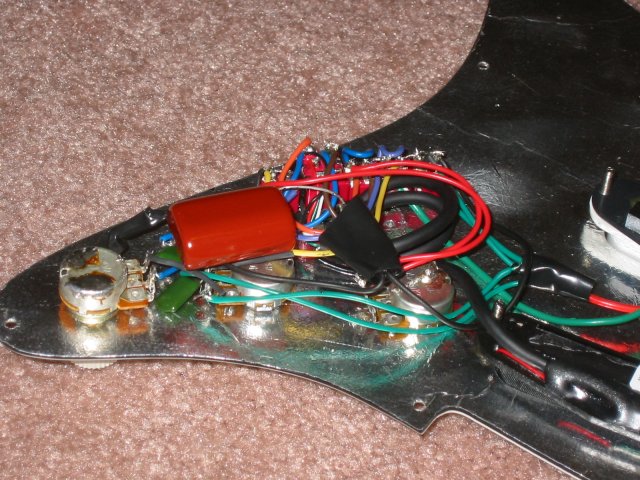
<p>This photo shows the completed wiring:</p>
<p><img src="http://www.cliffmccarthy.net/images/guitar_wiring/guitar_wiring01.jpg" alt="image"></p>
<p>The ring terminal that serves as the center of the star grounding is inside the black electrical tape.  The large brown capacitor connects the guitar&rsquo;s internal ground to the cavity shield and the strings.  This capacitor protects the player against shock resulting from DC voltage being applied to the cord.  The small green capacitors are for the tone knobs.</p>
<p>Along the back, there is a row of five toggle switches.  Most of these are on-off-on DPDT switches, but the second from the left is an on-on-on, for parallel/single/series humbucker switching.  It is also slightly bigger than the others, because I couldn&rsquo;t find a sub-mini on-on-on switch.</p>
<p>The coiled black wire is from the humbucker; I didn&rsquo;t want to hack off the excess wire because you never know when you might need it, and extending a shielded wire like that is tricky.  The electrical tape to the right of the picture shows where I had to do exactly that with the wire from one of the pickups.  Repeated re-wirings over the years eventually drove that pickup to the point where I had to splice and extend it.</p>
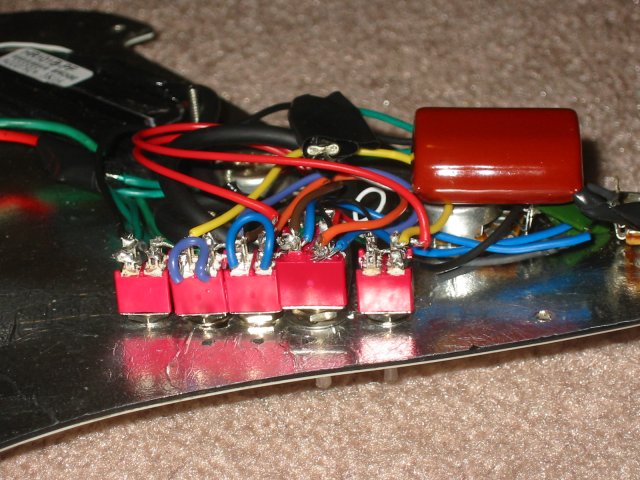
<p>This picture shows the wiring from the other side; here the switches are clearly visible:</p>
<p><img src="http://www.cliffmccarthy.net/images/guitar_wiring/guitar_wiring02.jpg" alt="image"></p>
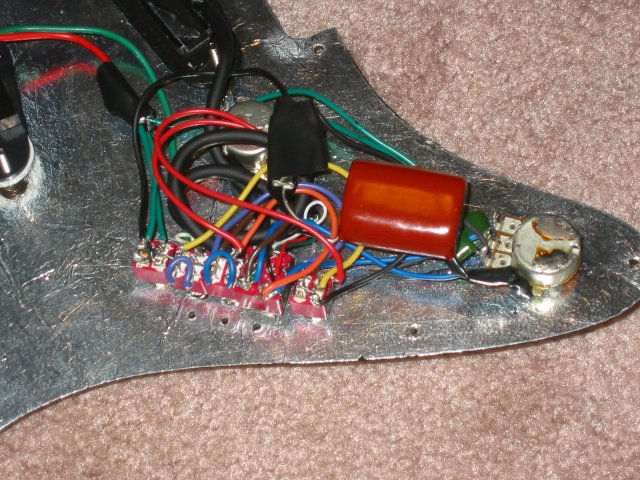
<p>Here is a top view, where it is easier to trace some of the wires:</p>
<p><img src="http://www.cliffmccarthy.net/images/guitar_wiring/guitar_wiring03.jpg" alt="image"></p>
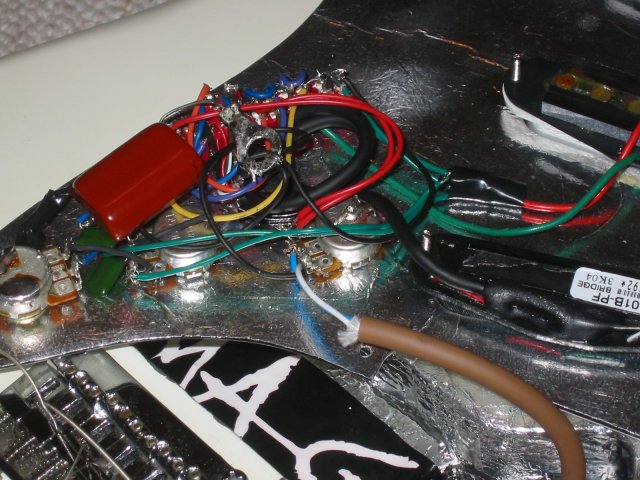
<p>This shot shows the ring terminal with the electrical tape off, and my band&rsquo;s sticker inside the body cavity.  (Putting a sticker inside like this improves the instrument&rsquo;s sound.)</p>
<p><img src="http://www.cliffmccarthy.net/images/guitar_wiring/guitar_wiring04.jpg" alt="image"></p>
<p>I mainly took these pictures so that I could review the wiring later without taking the guitar apart; they don&rsquo;t really show the &ldquo;how-to&rdquo; details of setting up a guitar this way.</p>
<p>More interesting is the schematic:</p>
<p>(which will be added much later)</p>
]]></content>
  </entry>
  <entry>
    <title type="html"><![CDATA[Peavey Rage 108 Footswitch Mod]]></title>
    <link href="https://www.cliffmccarthy.net/pages/Peavey_Rage_108_Footswitch_Mod/"/>
    <published>2006-06-10T04:43:09-05:00</published>
    <updated>2026-02-05T14:13:12-06:00</updated>
    <id>https://www.cliffmccarthy.net/pages/Peavey_Rage_108_Footswitch_Mod/</id>
    <content type="html"><![CDATA[<p>I got my electric guitar back in 1987.  As a kid with not much money and no job, I was intent of minimizing cost as much as possible.  So I figured I didn&rsquo;t need an amp; I could just play it through my stereo.  But after attempting that for a while, I learned that an electric guitar played through a stereo sounds nothing like Jimmy Page, or Steve Howe, or any of the other electric guitar sounds that I loved.</p>
<p>Years went by, and I eventually learned that the amp was an important part of making an electric guitar really rock.  (I hadn&rsquo;t discovered effects yet&mdash;that came later.  Bwahahahaha!)  I was still on a budget, so I went for the cheapest amp I could get my hands on.  Some time in 1991, I think it was, I went to Whittaker Music (with my grandmother, if I remember right) and bought a Peavey Rage 108.  This was back in the days of the Gorilla amp&mdash;remember those?  The Rage 108 was similar and about the same price, but seemed somewhat better constructed to me.</p>
<p>It turns out that this $100 amp is actually a nice little amplifier.  You can get some decent sound out of it, and the distortion channel sounds good and crunchy.  When you consider how small and lightweight the thing is, it&rsquo;s a pretty handy piece of equipment.</p>
<p>But, the one thing that always frustrated me about it was that it&rsquo;s hard to switch channels on it while playing.  The channel selector switch is a tiny little toggle switch nestled in between two knobs.  So you either have to set the amp up where you can easily reach it with your hand while you&rsquo;re playing (and even then it&rsquo;s a pain), or you need to try to poke at the switch with your foot, which is more likely to spin the adjacent knobs and mess up your settings.</p>
<p>So what I really wanted was the ability to switch channels with a footswitch.  I searched around on-line and didn&rsquo;t find any information about mods for doing this, so I decided to dive in and figure out how to do it on my own.</p>
<p>It turns out that it&rsquo;s really pretty simple to add a footswitch, so here are my notes on what I did to add one to my amp.</p>
<hr>
<p>Disclaimer: Use this information at your own risk. If following this advice causes your amp to emit purple smoke, it&rsquo;s your own fault, unless you think that&rsquo;s cool, in which case it&rsquo;s still your own fault.</p>
<p>First, you have to get the &ldquo;head&rdquo; out of the &ldquo;cabinet&rdquo;.  To do this, you unscrew the four screws on the top (the ones that don&rsquo;t appear to be holding anything on from the outside):</p>
<p><img src="http://www.cliffmccarthy.net/images/peavey_rage108_footswitch/top_screws.jpg" alt="image"></p>
<p>(Having the head held in by screws from the top like this seems to be a pretty standard setup for Peavey amplifiers.)</p>
<p>Before you pull the head out, disconnect the wires from the speaker.  They are connected with spade lug connectors, so they just pull off.  Note which wire is which so you can re-connect it later.  You should then be able to slide the head completely out of the cabinet.</p>
<p>Inside the head, there is a circuit board.  A variety of things stand in the way of removing the board.  You will need to remove the front knobs by pulling them straight off.  The jacks have hex nuts around them; use a wrench to remove those.  The board is also held in by several screws; unscrew them.</p>
<p>Once the board is loose, you should be able to pull it out of the sheet metal enclosure:</p>
<p><img src="http://www.cliffmccarthy.net/images/peavey_rage108_footswitch/removed_board.jpg" alt="image"></p>
<p>It will still be connected to the sheet metal by several wires, but you should be able to manipulate it enough to get it to where you can access both sides of it easily.  Be extra careful with the speaker wires when pulling it out.  they are held in place by a couple stiff protuding connectors which can get caught up on the square hole in the sheet metal, and the sheet metal may nick the wires:</p>
<p><img src="http://www.cliffmccarthy.net/images/peavey_rage108_footswitch/nicked_wires.jpg" alt="image"></p>
<p>Next, remove the channel switch by desoldering it:</p>
<p><img src="http://www.cliffmccarthy.net/images/peavey_rage108_footswitch/desoldered_board.jpg" alt="image"></p>
<p>Note that four of the pins are bent over; you will need to carefully straighten them out to remove the switch.</p>
<p>With the switch free, bend back two of the pins, as shown.  (You could cut them off, but I wanted to make sure I could undo all this if it didn&rsquo;t work.)  We are going to re-route these pins through a jack on the back of the amp.  Note that the pins on the top are connected to the corresponding ones on the bottom; this fact will come in handy.</p>
<p><img src="http://www.cliffmccarthy.net/images/peavey_rage108_footswitch/switch_bent_pins.jpg" alt="image"></p>
<p>We will need to run four wires from the switch and board to the back of the amp.  I used a four-conductor-plus-shield microphone cable for this.  Solder two of the wires to the top pins corresponding to the bent ones:</p>
<p><img src="http://www.cliffmccarthy.net/images/peavey_rage108_footswitch/switch_with_wires.jpg" alt="image"></p>
<p>Solder the shield (or a fifth wire, if you don&rsquo;t have a cable like this available) to the center pin:</p>
<p><img src="http://www.cliffmccarthy.net/images/peavey_rage108_footswitch/switch_with_wires2.jpg" alt="image"></p>
<p>At the other end of this short piece of cable, we&rsquo;ll add a jack to allow the footswitch to be plugged in.  We need a 1/4&quot; tip-ring-sleeve jack with &ldquo;closed tip, closed ring&rdquo; switches, like the Switchcraft 14B
(<a href="http://www.mouser.com/">Mouser</a> part number 502-14B).
Make sure the cable is long enough to reach from the switch to the back of the head, and solder on the jack:</p>
<p><img src="http://www.cliffmccarthy.net/images/peavey_rage108_footswitch/jack.jpg" alt="image"></p>
<p>Note how the wires are in pairs, with the two white ones &ldquo;normalled&rdquo; to each other, and the same for the two blue ones.  The shield is connected to the sleeve contact.  It doesn&rsquo;t really matter which pair of wires goes to the tip and which goes to the ring.  However, it &lsquo;&lsquo;is&rsquo;&rsquo; important how each pair is connected.  The wire attached to the channel switch should be the one that is disconnected from the plug when the plug is inserted.  The other wire (which will be connected to the circuit board next) should be connected to the plug when a plug is inserted.  Verify this with a continuity tester to save yourself headache later.</p>
<p>Back at the switch end, solder the two free wires to the circuit board, in the two holes that were previously occupied by the pins that are now bent up.  Put the switch back and solder it in, making sure that the bent pins do not make contact with the exposed part of the wires soldered to the board:</p>
<p><img src="http://www.cliffmccarthy.net/images/peavey_rage108_footswitch/switch_replaced.jpg" alt="image"></p>
<p>Be careful not to scratch up your circuit board like I did:</p>
<p><img src="http://www.cliffmccarthy.net/images/peavey_rage108_footswitch/resoldered_board.jpg" alt="image"></p>
<p>To help ensure you don&rsquo;t nick your speaker wires, I recommend padding the edge of the square hole with some electrical tape:</p>
<p><img src="http://www.cliffmccarthy.net/images/peavey_rage108_footswitch/tape_sticker.jpg" alt="image"></p>
<p>(Be sure to put your band&rsquo;s sticker on the inside as well!  It makes it sound better.)</p>
<p>Mount the circuit board back in the enclosure, and put back the knobs and nuts on the front panel:</p>
<p><img src="http://www.cliffmccarthy.net/images/peavey_rage108_footswitch/reassembled_head.jpg" alt="image"></p>
<p>Drill a hole in the back and mount the jack.  A five-wired jack like this is kind of bulky, so you may have to fiddle with it a bit to get it to fit right.</p>
<p>Now we need to build the footswitch itself.  It&rsquo;s just a SPDT switch with a tip-ring-sleeve plug.  Attach the plug to one end of a shielded two-conductor cable:</p>
<p><img src="http://www.cliffmccarthy.net/images/peavey_rage108_footswitch/plug.jpg" alt="image"></p>
<p>Attach the shield to the sleeve; it doesn&rsquo;t really matter which wire goes to the tip and which goes to the ring.</p>
<p>Drill two holes in a small enclosure.  One will hold the switch and the other will admit the cable.  Attach the switch to the cable, with the common terminal connected to the shield:</p>
<p><img src="http://www.cliffmccarthy.net/images/peavey_rage108_footswitch/switch1.jpg" alt="image"></p>
<p>Then mount the switch in place.  I like using a cable tie as a strain relief:</p>
<p><img src="http://www.cliffmccarthy.net/images/peavey_rage108_footswitch/switch2.jpg" alt="image"></p>
<p>You then should be ready to go!  Apart from the jack on the back, there is really no sign that anything is different about the amp:</p>
<p><img src="http://www.cliffmccarthy.net/images/peavey_rage108_footswitch/jack_on_back.jpg" alt="image"></p>
<p>(Also notice how easily the footswitch can be stashed inside the amp.)</p>
<p>The front switch now sits at a little bit of an angle because the wires run underneath it to the circiut board.  But it&rsquo;s hardly noticeable:</p>
<p><img src="http://www.cliffmccarthy.net/images/peavey_rage108_footswitch/rage108_front.jpg" alt="image"></p>
<p>When the footswitch is not plugged in, the front switch works like it always did.  When the footswitch is plugged in, it overrides the switch, allowing you to change channels without missing a beat.</p>
<p>Rock on!</p>
]]></content>
  </entry>
  <entry>
    <title type="html"><![CDATA[Moog Rogue Trim Pots]]></title>
    <link href="https://www.cliffmccarthy.net/pages/Moog_Rogue_Trim_Pots/"/>
    <published>2006-06-09T01:32:41-05:00</published>
    <updated>2026-04-02T12:22:08-05:00</updated>
    <id>https://www.cliffmccarthy.net/pages/Moog_Rogue_Trim_Pots/</id>
    <content type="html"><![CDATA[<h2 id="tweaking-your-moog-rogue">Tweaking your Moog Rogue</h2>
<p>Disclaimer: Use this information at your own risk. If following this advice causes your Moog to emit purple smoke, it&rsquo;s your own fault, unless you think that&rsquo;s cool, in which case it&rsquo;s still your own fault.</p>
<p>Have you ever wondered what the nine trim pots on the back of a Moog Rogue are for? I did, and so I did some experiments to figure it out. Since there isn&rsquo;t any information about this on the web, I decided to write up my results. The information in this document is purely the result of my own research; I have never seen the Moog service manual.</p>
<p>(In the time since I originally wrote this, I came across some more information about adjusting the trimpots, at:
<a href="http://search.retrosynth.com/ah/search/lookit.cgi?-v9907.116">http://search.retrosynth.com/ah/search/lookit.cgi?-v9907.116</a>.  You might want to refer to that information too.)</p>
<p>Across the back of a Moog Rogue, you&rsquo;ll find nine trim pots. I only was able to figure out what eight of them did; the ninth one (near the power switch) seems to have some vague effect on tone or volume, but I have no idea what it really does. I will refer to the others as 1 through 8 as shown in this photo:</p>
<p><img src="http://www.cliffmccarthy.net/images/moog_rogue/moog_rogue_trimpots.jpg" alt="image"></p>
<p>As best as I can discern, these trim pots function as follows:</p>
<ul>
<li>Keyboard control voltage adjustment</li>
<li>Octave switch range</li>
<li>Oscillator 1 pitch</li>
<li>Oscillator 1 range</li>
<li>Oscillator 2 range</li>
<li>Oscillator 2 pitch</li>
<li>Oscillator 1 keyboard tracking</li>
<li>Oscillator 2 keyboard tracking</li>
</ul>
<p>Notes about these adjustments:</p>
<h2 id="1-keyboard-control-voltage-adjustment">1. Keyboard control voltage adjustment</h2>
<p>This adjustment allows you to adjust the voltage output range of the keyboard, and should be the first thing you tweak. To measure it, connect a cable to the &ldquo;keyboard in/out&rdquo; jack on the back. Like the panel says, be sure you use a stereo (tip-ring-sleeve) plug. I find an insert cable handy for this. Using a voltmeter, measure the voltage between the tip and the sleeve. The voltages should be as follows:</p>
<div class="codeblock"><pre tabindex="0"><code>Low F       0.000 V
Low B       0.500 V
Middle F    1.000 V
Middle B    1.500 V
High F      2.000 V
High B      2.500 V</code></pre></div><p>The low F voltage remains fixed, all the other voltages change as the trim pot is adjusted. You probably won&rsquo;t find a setting that exactly hits the right values at every point on the keyboard; aim for the setting that gets the closest overall.</p>
<h2 id="2-octave-switch-adjustment">2. Octave switch adjustment</h2>
<p>This pot controls the spacing between the octaves as selected by the octave switch on the front panel:</p>
<p><img src="http://www.cliffmccarthy.net/images/moog_rogue/moog_rogue_octave.jpg" alt="image"></p>
<p>Initially set the switch to 32&rsquo;, as this setting is unaffected by the trim pot. Turn on just Oscillator 1 and get a reference note in tune, using some combination of the pitch bender, the tuning knob, or the other trimpots. Then, with the switch in the 16&rsquo; and 8&rsquo; positions, adjust the trim pot until all three octaves are in tune.</p>
<h2 id="3-oscillator-1-pitch--6-oscillator-2-pitch">3. Oscillator 1 pitch / 6. Oscillator 2 pitch</h2>
<p>I think this is a straight pitch tuning adjustment for each oscillator. Before tuning the oscillators, set the tune knob straight up and the interval to &ldquo;unison&rdquo;:</p>
<p><img src="http://www.cliffmccarthy.net/images/moog_rogue/moog_rogue_tune.jpg" alt="image">
<img src="http://www.cliffmccarthy.net/images/moog_rogue/moog_rogue_interval.jpg" alt="image"></p>
<p>The range covered by the trim pots is quite large&mdash;about an octave. If you find that you are having to turn the pot to its limit to get anywhere near the right note, your pitch bender may be out of adjustment. The pitch bend wheel is held in place by a set screw that is accessed through the hole in the finger notch at the crest of the wheel. Use an allen wrench to adjust it. (You&rsquo;ll have to guess at the size.) If you center the pitch trim pots then turn the pitch bender until you hit approximately the right pitch, you can then loosen and re-center the pitch bender. Make sure you can still turn the wheel through its full range without hitting the limit of the pitch bender pot. Once the bender is approximately in the right place, adjust the oscillator trim pots again.</p>
<h2 id="4-oscillator-1-range--5-oscillator-2-range">4. Oscillator 1 range / 5. Oscillator 2 range</h2>
<p>I&rsquo;m not exactly sure what the relationship is between these pots and 7 &amp; 8. My guess is that 4 &amp; 5 are adjustments internal to the oscillators, while 7 &amp; 8 control the degree that the keyboard control voltage affects the pitch. To get these in tune, check notes across the whole range of the keyboard. Tune a low note using trim pot 3 or 6 (depending on the oscillator), then check a high note and adjust this trim pot until the high note is in tune. Then go back to the low note, which may have drifted a bit, and adjust trim pot 3 or 6 again. You will probably have to iterate this process a bit until you hit the right combination. When everything is adjusted correctly, you should be able to play both oscillators in unison across the whole keyboard without them &ldquo;beating&rdquo; anywhere along it.</p>
<h2 id="7-oscillator-1-keyboard-tracking--8-oscillator-2-keyboard-tracking">7. Oscillator 1 keyboard tracking / 8. Oscillator 2 keyboard tracking</h2>
<p>I&rsquo;m not sure how tweaking these is different from tweaking 4 &amp; 5, so you&rsquo;re on your own here.</p>
]]></content>
  </entry>
  <entry>
    <title type="html"><![CDATA[Contact Info]]></title>
    <link href="https://www.cliffmccarthy.net/pages/Contact_Info/"/>
    <published>2006-06-09T01:03:08-05:00</published>
    <updated>2026-03-15T17:57:10-05:00</updated>
    <id>https://www.cliffmccarthy.net/pages/Contact_Info/</id>
    <content type="html"><![CDATA[<p>For now you&rsquo;ll just have to guess how to e-mail me.  You could also
try messaging me at the Fediverse address on my main page.</p>
]]></content>
  </entry>
  <entry>
    <title type="html"><![CDATA[Film]]></title>
    <link href="https://www.cliffmccarthy.net/pages/Film/"/>
    <published>2006-05-18T16:21:13-05:00</published>
    <updated>2026-04-02T12:22:08-05:00</updated>
    <id>https://www.cliffmccarthy.net/pages/Film/</id>
    <content type="html"><![CDATA[<p>Sometimes I help make movies, or &ldquo;films&rdquo;, as we call them when we want to sound all pretentious and artistic.  I generally do this with some friends, calling ourselves Brand-O.  We started out making films for the Dallas 24-hour video race, put on by the
<a href="http://www.dallasvideo.org/">Video Association of Dallas</a>,
but we have started making random recreational films in our free time as well.</p>
<p>We also dig
Smoking Crayolas,
because they&rsquo;re cool.</p>
<hr>
<p>The
<a href="http://www.dallasvideo.org/">Video Association of Dallas</a>
has also started putting on a 24-hour film race called Guts and Glory, and in 2008 they started including Super 8 as well as 16mm.  Here are some useful Super 8 links:</p>
<ul>
<li><a href="http://super8wiki.com/">http://super8wiki.com/</a></li>
<li><a href="http://www.dwaynesphoto.com/">http://www.dwaynesphoto.com/</a></li>
<li><a href="http://www.spectrafilmandvideo.com/">http://www.spectrafilmandvideo.com/</a></li>
<li><a href="http://www.yalefilmandvideo.com/">http://www.yalefilmandvideo.com/</a></li>
</ul>
]]></content>
  </entry>
  <entry>
    <title type="html"><![CDATA[About this Site]]></title>
    <link href="https://www.cliffmccarthy.net/pages/About_This_Site/"/>
    <published>2006-05-10T20:30:31-05:00</published>
    <updated>2026-03-15T17:52:02-05:00</updated>
    <id>https://www.cliffmccarthy.net/pages/About_This_Site/</id>
    <content type="html"><![CDATA[<p>Many years ago, I set this site up using the
<a href="https://oddmuse.org/">OddMuse</a>
wiki software as a sort of low-overhead CMS and markdown-to-HTML
engine, giving me a sort of &ldquo;Web 2.0&rdquo; interface for managing pages.
Over time, I came to want a better way of managing the content, and
the long-overdue arrival of static site generators finally gave me the
kind of interface and control I had always wanted, without any of the
security concerns of rendering pages by running code in response to
HTTP requests.  I replaced the site with static HTML scraped from the
OddMuse-powered site, and began working on adapting the site to the
<a href="https://gohugo.io/">Hugo SSG</a>.
That took a long time for various reasons, but that process is now
complete, and this site is a solidly &ldquo;Web 1.0&rdquo; experience.</p>
<p>The styling of the site is based to some extent on the
<a href="https://github.com/jekyll/minima">&ldquo;minima&rdquo; theme</a>
from the
<a href="https://jekyllrb.com/">Jekyll SSG</a>,
which I experimented with for a while as I was exploring static site
generators.  I switched to Hugo because I find it easier to manage
dependencies and stay up-to-date with a program written in Go.</p>
<p>I like the concept of
<a href="https://brutalist-web.design/">Brutalist Web Design</a>
and adhere to some of its principles to keep this site simple and usable.</p>
]]></content>
  </entry>
  <entry>
    <title type="html"><![CDATA[Computers]]></title>
    <link href="https://www.cliffmccarthy.net/pages/Computers/"/>
    <published>2006-05-10T01:09:03-05:00</published>
    <updated>2026-04-02T12:22:08-05:00</updated>
    <id>https://www.cliffmccarthy.net/pages/Computers/</id>
    <content type="html"><![CDATA[<h2 id="software-engineering">Software engineering</h2>
<ul>
<li><a href="http://www.joelonsoftware.com/">http://www.joelonsoftware.com/</a></li>
</ul>
<h2 id="usability">Usability</h2>
<ul>
<li><a href="http://www.w3.org/Provider/Style/URI.html">Cool URIs don&rsquo;t change</a></li>
<li><a href="http://www.useit.com/alertbox/991003.html">http://www.useit.com/alertbox/991003.html</a></li>
<li><a href="http://www.useit.com/alertbox/20040503.html">http://www.useit.com/alertbox/20040503.html</a></li>
<li><a href="http://www.useit.com/alertbox/20040510.html">http://www.useit.com/alertbox/20040510.html</a></li>
<li><a href="http://www.useit.com/alertbox/weblogs.html">http://www.useit.com/alertbox/weblogs.html</a></li>
<li><a href="http://www.useit.com/alertbox/20020512.html">http://www.useit.com/alertbox/20020512.html</a></li>
<li><a href="http://www.useit.com/alertbox/20050523.html">http://www.useit.com/alertbox/20050523.html</a></li>
</ul>
<h2 id="blog--wiki-packages">Blog / Wiki packages</h2>
<ul>
<li><a href="http://www.oddmuse.org/">http://www.oddmuse.org/</a></li>
<li><a href="http://fromage.sourceforge.net/">http://fromage.sourceforge.net/</a></li>
</ul>
<h2 id="software">Software</h2>
<ul>
<li><a href="http://www.kernel.org/">http://www.kernel.org/</a> for the only operating system you&rsquo;ll ever want</li>
<li><a href="http://www.slackware.com/">http://www.slackware.com/</a> for the most &ldquo;classic Unix&rdquo; Linux distribution
<ul>
<li>Slackware 12.0 (or maybe it was 11.0) dropped GNOME, so to compile handy tools like grip and gthumb, you need something like:
<ul>
<li>dropline GNOME</li>
<li><a href="http://gsb.freerock.org/">Freerock GNOME</a></li>
<li>GWARE</li>
</ul>
</li>
</ul>
</li>
<li><a href="http://www.nongnu.org/viewmail/">View Mail (VM) for Emacs</a></li>
<li><a href="http://www.mplayerhq.hu/">MPlayer</a></li>
<li><a href="http://linux.oneandoneis2.org/LNW.htm">Linux is not Windows</a></li>
<li><a href="http://www.rahul.net/dholmes/ctorrent/">Enhanced CTorrent</a> - super simple BitTorrent command-line interface</li>
<li>Sendmail / SSL
<ul>
<li><a href="http://www.linuxquestions.org/questions/slackware-14/sendmail-smtp-auth-howto-224543/">http://www.linuxquestions.org/questions/slackware-14/sendmail-smtp-auth-howto-224543/</a></li>
<li><a href="http://aput.net/~jheiss/sendmail/tlsandrelay.shtml">http://aput.net/~jheiss/sendmail/tlsandrelay.shtml</a></li>
</ul>
</li>
<li><a href="http://www.sentex.net/~mwandel/jhead/">jhead</a>, a tool for working with EXIF data in JPEG files</li>
</ul>
<h2 id="networking">Networking</h2>
<ul>
<li><a href="http://www.homephonewiring.com/add-line3.html">Wiring for a Third Phone Line</a></li>
</ul>
<h2 id="games">Games</h2>
<ul>
<li><a href="http://www.ddrfreak.com/">http://www.ddrfreak.com/</a></li>
</ul>
<h2 id="philosophy">Philosophy</h2>
<ul>
<li>Koans
<ul>
<li><a href="http://en.wikipedia.org/wiki/Hacker_koan">Hacker Koan</a> from Wikipedia</li>
<li><a href="http://www.catb.org/jargon/html/koans.html">Some AI Koans</a></li>
<li><a href="http://www.catb.org/~esr/writings/unix-koans/">Rootless Root</a> &ndash; the Unix Koans of Master Foo</li>
<li><a href="http://www.catb.org/~esr/jargon/html/koans.html">Some AI Koans</a></li>
</ul>
</li>
<li><a href="http://www.canonical.org/~kragen/tao-of-programming.html">The Tao of Programming</a></li>
<li><a href="http://vrici.lojban.org/~cowan/upc/">The Unix Power Classic</a></li>
<li><a href="http://www.jwz.org/doc/tabs-vs-spaces.html">Jamie Zawinski on tabs versus spaces</a></li>
<li><a href="https://coosoft.wordpress.com/2013/02/24/the-perl-vs-python-debate/">Perl versus Python</a></li>
</ul>
<h2 id="other">Other</h2>
<ul>
<li><a href="http://www.hpecodewars.org/">http://www.hpecodewars.org/</a></li>
<li><a href="../Hard_Drive_Recovery/">Hard Drive Recovery</a></li>
</ul>
]]></content>
  </entry>
  <entry>
    <title type="html"><![CDATA[The Denton Institute of Phrenology]]></title>
    <link href="https://www.cliffmccarthy.net/pages/The_Denton_Institute_of_Phrenology/"/>
    <published>2006-05-08T12:27:32-05:00</published>
    <updated>2026-04-02T12:22:08-05:00</updated>
    <id>https://www.cliffmccarthy.net/pages/The_Denton_Institute_of_Phrenology/</id>
    <content type="html"><![CDATA[<p>The Denton Institute of Phrenology is a marching band that spontaneously
takes form on the Fourth of July in Denton, Texas.  It is led by Jeffrey
Barnes, the woodwind-playing genius from Brave Combo.
It is the only marching band I am aware of that incudes guitar,
melodica, accordion, violin, and a Kikkoman drum set.  In 2007, it also
featured Paul Slavens playing a totally phat Casio SK-1 through a boom
box that added tasty distortion. We perform
patriotic pieces like &ldquo;This Land is Your Land&rdquo;, &ldquo;Yellow Rose of Texas&rdquo;,
and &ldquo;You&rsquo;re a Grand Old Flag&rdquo;, in keys called out by Jeffrey the morning
of the event.  The group also includs a precision drill team, who are no
longer confined to the machine shop, thanks to modern rechargable
battery technology.</p>
<p>We dress patriotically and wear hats.</p>
<p>And remember, &ldquo;This Land is Your Land&rdquo; starts on the IV chord.</p>
]]></content>
  </entry>
  <entry>
    <title type="html"><![CDATA[Kobushi]]></title>
    <link href="https://www.cliffmccarthy.net/pages/Kobushi/"/>
    <published>2006-05-08T12:14:20-05:00</published>
    <updated>2026-03-15T18:03:09-05:00</updated>
    <id>https://www.cliffmccarthy.net/pages/Kobushi/</id>
    <content type="html"><![CDATA[<p>Kobushi is a Japanese taiko percussion group based in the Dallas area.
I played with them in 2004.  Big drums, jumping, and shouting.  It&rsquo;s a
lot of fun.</p>
]]></content>
  </entry>
  <entry>
    <title type="html"><![CDATA[Magpu]]></title>
    <link href="https://www.cliffmccarthy.net/pages/Magpu/"/>
    <published>2006-05-08T11:58:26-05:00</published>
    <updated>2026-01-27T14:58:47-06:00</updated>
    <id>https://www.cliffmccarthy.net/pages/Magpu/</id>
    <content type="html"><![CDATA[<p>I first saw
<a href="http://www.magpu.com/">Magpu</a>
in May 1998, and immediately dug their unique sound.  Over the following
year, I became friends with the band, and started occasionally sitting
in on various types of percussion.  In October 1999, I joined them on
MalletKAT for the Project Pu recording sessions.  This led to an
invitation to play with them at their Club Dada gig on 22 November 1999,
and I was with the group from that point onward.  The departure of
bassist Kyle Grundmann brought about our &ldquo;farewell&rdquo; show on 13 September
2002.  We played three more gigs after that, in different
configurations; as of 2006, our last public show was as a quartet on 22
May 2003, though I hope we&rsquo;ll have a reunion performance some day.</p>
]]></content>
  </entry>
  <entry>
    <title type="html"><![CDATA[Music]]></title>
    <link href="https://www.cliffmccarthy.net/pages/Music/"/>
    <published>2006-05-07T03:05:06-05:00</published>
    <updated>2026-04-02T12:22:08-05:00</updated>
    <id>https://www.cliffmccarthy.net/pages/Music/</id>
    <content type="html"><![CDATA[<h2 id="recordings-ive-made">Recordings I&rsquo;ve made</h2>
<ul>
<li>I&rsquo;ve started recording <a href="../Songs2011">some different stuff</a> for 2011.</li>
<li>I&rsquo;m still writing <a href="../Songs2010">12 stupid songs</a> for 2010.</li>
<li>In 2005, I recorded a CD entitled &lsquo;&lsquo;It Never Stopped Me Before&rsquo;&rsquo;.</li>
</ul>
<h2 id="bands-i-have-played-in">Bands I have played in</h2>
<ul>
<li><a href="../Magpu">Magpu</a></li>
<li><a href="../Kobushi">Kobushi</a></li>
<li><a href="../Escher's_Elevator">Escher&rsquo;s Elevator</a></li>
<li><a href="../The_Denton_Institute_of_Phrenology">The Denton Institute of Phrenology</a></li>
</ul>
<h2 id="equipment">Equipment</h2>
<ul>
<li>Deagan 1100 Vibraharp (a.k.a. vibraphone)</li>
<li>MalletKAT</li>
<li>Other Percussion</li>
<li>Guitars</li>
<li>Keyboards</li>
<li>Woodwinds</li>
<li>Also see the <a href="../Projects">Projects</a> page for some equipment-hacking I have done.</li>
</ul>
<h2 id="listening">Listening</h2>
<ul>
<li><a href="../Late_Night_Bands">Late Night Bands</a></li>
</ul>
<h2 id="theory">Theory</h2>
<ul>
<li>I have some crazy ideas about music theory.  Some day I might describe some of them here.</li>
</ul>
<h2 id="resources">Resources</h2>
<ul>
<li><a href="http://www.freedb.org/">http://www.freedb.org/</a></li>
<li><a href="http://www.tonepad.com/">http://www.tonepad.com/</a> - Guitar effect circuits</li>
<li><a href="http://www.hipshotproducts.com/">http://www.hipshotproducts.com/</a> - Guitar hardware upgrades</li>
</ul>
<h2 id="live-music-archive-contributions">Live Music Archive contributions</h2>
<p>Sometimes I tape performances.  Sometimes I upload shows to the Live Music Archive.  Like these:</p>
<ul>
<li><a href="http://www.archive.org/details/db2009-09-18.at4041">http://www.archive.org/details/db2009-09-18.at4041</a></li>
<li><a href="http://www.archive.org/details/db2009-02-08.at4041">http://www.archive.org/details/db2009-02-08.at4041</a></li>
<li><a href="http://www.archive.org/details/lotus2008-01-31.at4041.flac16">http://www.archive.org/details/lotus2008-01-31.at4041.flac16</a></li>
<li><a href="http://www.archive.org/details/EMRAG2007-07-10">http://www.archive.org/details/EMRAG2007-07-10</a></li>
<li><a href="http://www.archive.org/details/particle2002-03-17.at4053.flac16">http://www.archive.org/details/particle2002-03-17.at4053.flac16</a></li>
<li><a href="http://www.archive.org/details/jfjo2001-09-11">http://www.archive.org/details/jfjo2001-09-11</a></li>
<li><a href="http://archive.org/details/snarkypuppy2009-03-11.at4041">http://archive.org/details/snarkypuppy2009-03-11.at4041</a></li>
</ul>
]]></content>
  </entry>
  <entry>
    <title type="html"><![CDATA[McCarthy]]></title>
    <link href="https://www.cliffmccarthy.net/pages/McCarthy/"/>
    <published>2006-05-06T16:06:11-05:00</published>
    <updated>2026-03-15T18:08:58-05:00</updated>
    <id>https://www.cliffmccarthy.net/pages/McCarthy/</id>
    <content type="html"><![CDATA[<p>The keeper of this site.</p>
<p>Once I had one of those
<a href="http://www.myspace.com/tallforahobbit">myspace</a>
thingamajiggys, but we know what became of all that.
<a href="http://www.facebook.com/tallforahobbit">Facebook</a>
is somtimes useful, but not the best use of my time.</p>
<p>I invented the following U.S. patents:</p>
<ul>
<li>8,209,413</li>
<li>8,112,756</li>
<li>7,996,846</li>
<li>7,941,804</li>
<li><a href="http://www.google.com/patents?vid=USPAT7748005">7,748,005</a>: System and method for allocating a plurality of resources between a plurality of computing domains</li>
<li><a href="http://www.google.com/patents?vid=USPAT7228546">7,228,546</a>: Dynamic management of computer workloads through service level optimization</li>
<li><a href="http://www.google.com/patents?vid=USPAT7225223">7,225,223</a>: Method and system for scaling of resource allocation subject to maximum limits</li>
<li><a href="http://www.google.com/patents?vid=USPAT7143413">7,143,413</a>: Method and system for allocating system resources among applications using weights</li>
<li><a href="http://www.google.com/patents?vid=USPAT7140020">7,140,020</a>: Dynamic management of virtual partition computer workloads through service level optimization</li>
<li>and some others</li>
</ul>
]]></content>
  </entry>
  <entry>
    <title type="html"><![CDATA[Links]]></title>
    <link href="https://www.cliffmccarthy.net/pages/Links/"/>
    <published>2006-05-06T16:05:39-05:00</published>
    <updated>2026-04-02T12:22:08-05:00</updated>
    <id>https://www.cliffmccarthy.net/pages/Links/</id>
    <content type="html"><![CDATA[<h2 id="music-venues">Music Venues</h2>
<ul>
<li><a href="http://www.granadatheater.com/">The Granada Theater</a> (smoke free)</li>
<li><a href="http://thekessler.org/">Kessler Theater</a></li>
<li><a href="http://www.openingbellcoffee.com/">Opening Bell Coffee</a> (formerly Standard &amp; Pour&rsquo;s) (<a href="http://www.openingbellcoffee.com/calendar">calendar</a>) (smoke free)</li>
<li><a href="http://www.attpac.org/">AT&amp;T Performing Arts Center</a></li>
<li><a href="http://www.danssilverleaf.com/">Dan&rsquo;s Silverleaf</a></li>
<li><a href="http://www.jambase.com/">JamBase</a></li>
<li><a href="http://www.titas.org/">TITAS</a></li>
<li><a href="http://www.poordavidspub.com/">Poor David&rsquo;s Pub</a></li>
<li><a href="http://www.barleyhouse.com/">The Barley House</a></li>
<li><a href="https://www.basshall.com/">Bass Hall</a></li>
<li><a href="http://www.artandseek.org/">Art &amp; Seek</a> (KERA&rsquo;s art blog)</li>
</ul>
<h2 id="bands">Bands</h2>
<p>Dallas-ish</p>
<ul>
<li><a href="http://www.lossupervatos.com/">Los Super Vatos</a></li>
<li><a href="http://www.jfjo.com">Jacob Fred Jazz Odyssey</a></li>
<li><a href="http://www.oppositeday.com/">Opposite Day</a></li>
<li><a href="http://www.mopair.com/">Mo Pair</a>, Grass</li>
<li><a href="http://www.nakedlunch.net/">Naked Lunch</a></li>
</ul>
<p>Non-Dallas</p>
<ul>
<li><a href="http://www.djamkaret.com/">Djam Karet</a></li>
<li><a href="http://www.squonkopera.com/">Squonk Opera</a></li>
<li><a href="http://www.quintology.com/">Quintology</a></li>
<li><a href="http://www.jovisan.net/">Jovino Santos Neto</a></li>
<li><a href="http://www.kimmanning.com/">Kim Manning</a> (<a href="http://www.youtube.com/user/kimberlymanning">YouTube</a>)</li>
</ul>
<h2 id="radio">Radio</h2>
<ul>
<li><a href="http://www.kera.org/">KERA 90.1 FM</a></li>
<li><a href="http://www.knon.org/">KNON 89.3 FM</a></li>
</ul>
<h2 id="misc">Misc</h2>
<ul>
<li><a href="http://www.dma.org/">Dallas Museum of Art</a></li>
<li><a href="http://www.lugnet.com/">LUGNET - International LEGO Users Group Network</a></li>
<li><a href="http://www.discountedwheelwarehouse.com/Vehicle_Bolt_Pattern_Reference.cfm">Vehicle bolt pattern reference</a></li>
<li><a href="http://priuschat.com/forum/">Prius chat</a></li>
<li><a href="http://www.socalskateshop.com/">http://www.socalskateshop.com/</a></li>
<li><a href="http://www.vendian.org/mncharity/dir3/paper_rulers/">Printable Paper Rulers</a></li>
<li><a href="http://forums.nicoclub.com/datsun-720-forum.html">Datsun 720 Pickup forum</a></li>
</ul>
<h2 id="technology">Technology</h2>
<ul>
<li><a href="http://www.43folders.com/">http://www.43folders.com/</a></li>
</ul>
<h2 id="blogs">Blogs</h2>
<ul>
<li><a href="http://davidbrin.blogspot.com/">http://davidbrin.blogspot.com/</a></li>
<li><a href="http://thedailywtf.com/">http://thedailywtf.com/</a></li>
<li><a href="http://codemines.blogspot.com/">http://codemines.blogspot.com/</a></li>
<li><a href="http://www.schneier.com/blog/">http://www.schneier.com/blog/</a></li>
</ul>
<h2 id="more-social-networking-sites-than-anyone-needs">More Social Networking sites than anyone needs</h2>
<ul>
<li><a href="http://www.facebook.com/">http://www.facebook.com/</a></li>
<li><a href="http://www.myspace.com/">http://www.myspace.com/</a></li>
<li><a href="http://www.linkedin.com/">http://www.linkedin.com/</a></li>
</ul>
]]></content>
  </entry>
  <entry>
    <title type="html"><![CDATA[Projects]]></title>
    <link href="https://www.cliffmccarthy.net/pages/Projects/"/>
    <published>2006-05-06T16:03:19-05:00</published>
    <updated>2026-01-27T14:58:47-06:00</updated>
    <id>https://www.cliffmccarthy.net/pages/Projects/</id>
    <content type="html"><![CDATA[<ul>
<li><a href="../Moog_Rogue_Trim_Pots">Moog Rogue Trim Pots</a></li>
<li><a href="../Peavey_Rage_108_Footswitch_Mod">Peavey Rage 108 Footswitch Mod</a></li>
<li><a href="../Electric_Guitar_Wiring">Electric Guitar Wiring</a></li>
<li><a href="../Roland_D-50_Battery">Roland D-50 Battery</a></li>
</ul>
]]></content>
  </entry>
  <entry>
    <title type="html"><![CDATA[Hugo]]></title>
    <link href="https://www.cliffmccarthy.net/pages/hugo/"/>
    <published>0001-01-01T00:00:00+00:00</published>
    <updated>2026-03-16T07:52:58-05:00</updated>
    <id>https://www.cliffmccarthy.net/pages/hugo/</id>
    <content type="html"><![CDATA[<h2 id="goals">Goals</h2>
<ul>
<li><strong>Write text.</strong></li>
<li><strong>Link to things.</strong></li>
<li><strong>Organized pages.</strong></li>
<li><strong>Sequential posts.</strong></li>
<li><strong>Inline images.</strong></li>
<li><strong>rel=me</strong></li>
<li><strong>Inline audio playlist.</strong></li>
<li><strong>Inline video.</strong></li>
<li><strong>Consume it as source.</strong></li>
</ul>
<h2 id="notes">Notes</h2>
<p>content/pages/_index.md supersedes themes/fromblank/content/pages/_index.md.</p>
<p>&ldquo;Pages&rdquo; are just organized units of data that don&rsquo;t fall into an
ordered feed-like sequence.</p>
<p>If there is no front matter, the date renders as, &ldquo;January 1, 1&rdquo;.</p>
<h2 id="test-section">Test section</h2>
<p><a href="https://gohugo.io/content-management/diagrams/">this is a link</a></p>
<p><a href="../useful-links">this is also a link, relative to this page</a></p>
<p><a href="../..">this is a link to the top of the site</a></p>
<p>We have
<a href="../../pages">pages</a>,
<a href="../../posts">posts</a>.</p>
<div id="playlist">
  <audio id="audio" preload="auto" tabindex="0" controls="" type="audio/mpeg" src=""></audio>
  <ul>
<li>02:55 <a href="http://www.magpu.com/audio/2001-04-06/magpu2001-04-06d2t02.mp3">Burrito Transplant Surgery</a></li>
<li>03:02 <a href="http://www.magpu.com/audio/2001-04-06/magpu2001-04-06d2t03.mp3">Revenge of the Rather Large Burrito &gt;</a></li>
<li>03:20 <a href="http://www.magpu.com/audio/2001-04-06/magpu2001-04-06d2t04.mp3">Star Wars Disco Theme &gt;</a></li>
<li>03:13 <a href="http://www.magpu.com/audio/2001-04-06/magpu2001-04-06d2t05.mp3">Revenge of the Rather Large Burrito</a></li>
</ul>

</div>

]]></content>
  </entry>
  <entry>
    <title type="html"><![CDATA[Useful Links]]></title>
    <link href="https://www.cliffmccarthy.net/pages/useful-links/"/>
    <published>0001-01-01T00:00:00+00:00</published>
    <updated>2026-04-02T12:22:08-05:00</updated>
    <id>https://www.cliffmccarthy.net/pages/useful-links/</id>
    <content type="html"><![CDATA[<p>This was a page I created while prototyping Hugo.  I should replace it
with a redirect.</p>
]]></content>
  </entry>
</feed>